
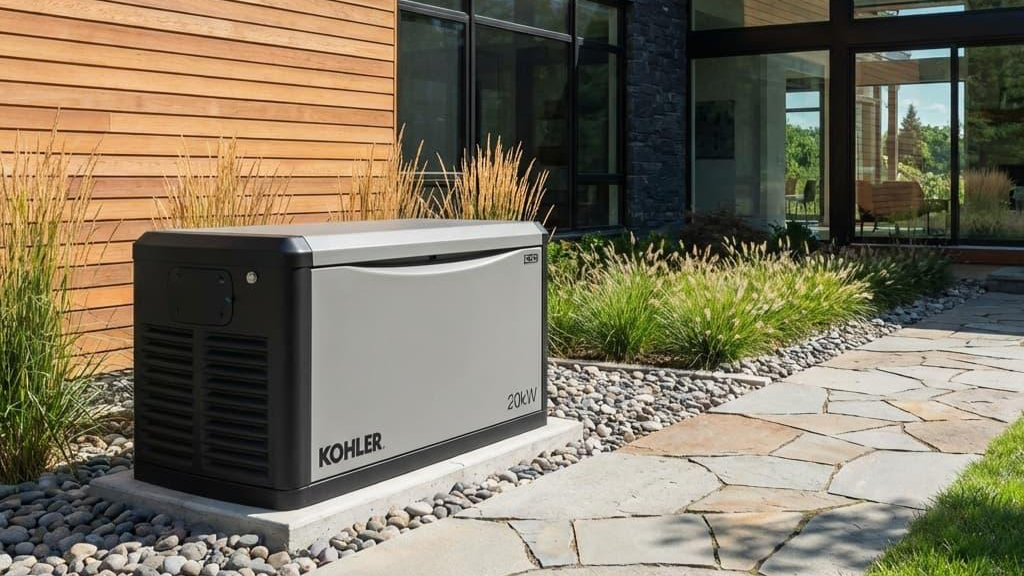
If you’re buying a whole house generator, one of the most important questions is also one of the most misunderstood:
What size generator do I actually need for my house?
For many homes, a standby generator between 14kW and 26kW can provide substantial backup power. Smaller homes or homeowners interested primarily in essential circuits may be able to use a 10kW–14kW generator, while larger homes, multiple air-conditioning systems, electric appliances and other high-demand equipment can push generator requirements above 20kW.
But generator sizing isn’t determined by square footage alone.
Your HVAC system, fuel type, electrical service, major appliances, starting loads and which circuits you expect to operate simultaneously all affect the appropriate generator size.
That’s why Illiana Pros recommends having a professional load assessment performed before purchasing a standby generator.
Here’s what homeowners should know.
Quick Answer: What Size Whole House Generator Do I Need?
As a general starting point:
| Generator Size | Typical Application |
|---|---|
| 10–12kW | Essential circuits and smaller homes |
| 14kW | Smaller to midsize homes and essential/expanded backup |
| 18–20kW | Midsize homes with more major systems |
| 22–24kW | Whole-home applications with higher electrical demand |
| 26kW+ | Larger homes and homes with multiple high-demand loads |
These ranges are general guidance, not a substitute for an electrical load calculation.
Kohler, for example, describes 10–14kW generators as appropriate for smaller homes or essential-circuit backup, 14–20kW for many midsize homes, and 20–26kW+ for larger homes or whole-home backup with greater electrical demand.
The important question isn’t simply, “How many square feet is my house?”
It’s:
“What do I want to continue operating when the power goes out?”
What Does kW Mean on a Whole House Generator?
Generator capacity is usually expressed in kilowatts (kW).
One kilowatt equals 1,000 watts.
A 20kW generator therefore has a nominal output of 20,000 watts under its specified operating conditions.
But there’s an important distinction between the electricity required to run an appliance and the additional power that may be required to start it.
Running Watts vs. Starting Watts
Running watts are the electricity an appliance needs while operating normally.
Starting watts are the temporary additional power some motor-driven equipment requires when starting.
This is particularly important with equipment such as:
- Central air conditioners
- Well pumps
- Sump pumps
- Refrigerator compressors
- Freezers
- Furnace blowers
- Pool equipment
A generator could theoretically have enough capacity to operate several appliances once they’re running but still struggle when a large motor attempts to start.
That is one reason professional generator sizing considers more than the total wattage printed on appliance labels.
What Size Generator Will Run a Whole House?
There is no single generator size that will run every house.
A small home with natural-gas heating, a gas water heater and gas cooking could have substantially lower electrical requirements than a similar-size home with electric heat, electric water heating, electric cooking and an EV charger.
Likewise, a 3,000-square-foot home with efficient gas appliances may sometimes have different generator requirements than a 2,000-square-foot all-electric home.
When sizing a whole house generator, consider:
- Home size
- Electrical service
- Air-conditioning equipment
- Heating system
- Water heater
- Refrigerator and freezer
- Well or sump pumps
- Electric range or oven
- Microwave
- Washer and dryer
- Garage door openers
- Pool or spa equipment
- EV charging
- Medical equipment
- Home office equipment
- Other large electrical loads
Then determine which of those systems must operate simultaneously during an outage.
Is a 10kW Generator Enough for a House?
A 10kW standby generator can be an excellent solution when the objective is to protect essential circuits rather than operate every electrical load in the house simultaneously.
Depending on the home’s actual electrical requirements, a properly designed smaller system may keep important equipment operating, such as:
- Refrigerator
- Freezer
- Lights
- Selected outlets
- Furnace blower
- Internet equipment
- Sump pump
- Certain other essential circuits
The limitation becomes apparent when homeowners expect to simultaneously operate central air conditioning, electric cooking, electric water heating, clothes dryers and other large loads.
This is why “10kW” should not automatically be interpreted as “too small.” The correct size depends on what you’re asking the generator to do.
Is a 14kW Generator Enough for a Whole House?
For some smaller or moderately equipped homes, 14kW can provide substantial backup capability.
For example, the Kohler 14RCA is rated at 14kW using LP and 12kW using natural gas.
This illustrates another important generator-sizing lesson:
Always Compare Natural Gas and Propane Ratings
A generator advertised using its maximum LP rating may produce less power when connected to natural gas.
Therefore, don’t choose a generator based only on the largest number in the model description.
Ask:
How many kilowatts does this specific generator produce using the fuel I will actually have at my house?
That’s especially important in Northwest Indiana and Chicagoland, where many residential standby installations use existing natural-gas service.
Is a 20kW Generator Enough to Run a Whole House?
A 20kW generator can provide whole-home backup for many homes, but it is not universally large enough for every house.
A 20kW-class generator becomes particularly attractive when homeowners want more than essential-circuit protection and expect to maintain much of their normal lifestyle during an outage.
Depending on the load calculation and system design, this could include:
- Central air conditioning
- Refrigeration
- Lighting
- Furnace equipment
- Kitchen circuits
- Home office
- TVs and electronics
- Sump or well pump
- Selected additional appliances
However, an all-electric home or a property with multiple HVAC systems, large pumps, electric water heaters or other high-demand equipment may require more capacity or intelligent load management.
Bottom line: 20kW is a generator capacity—not a guarantee that every circuit in every home can operate simultaneously.
When Should You Consider a 22kW, 24kW or 26kW Generator?
Moving into the 22–26kW range provides additional capacity for homeowners who want greater whole-home capability.
These generators are commonly considered for larger homes or homes with heavier electrical loads.
For example, a homeowner might consider this range when the house has:
- Larger central A/C equipment
- Multiple HVAC systems
- Electric cooking
- Electric water heating
- Multiple refrigerators or freezers
- Well pumps
- Sump pumps
- Pool equipment
- Hot tubs
- Larger home offices
- More simultaneous electrical demand
The Kohler 26RCA provides a good example of why fuel ratings still matter at this size. It is rated at 26kW on LP and 24kW on natural gas.
More capacity can provide additional flexibility, but bigger isn’t automatically better.
The objective should be to purchase the correctly sized generator, not simply the largest generator available.
14kW vs. 20kW vs. 26kW Generator: Which Should You Choose?
Here’s a simplified way to think about the three categories.
Choose approximately 14kW when:
You have a smaller or moderately sized home, many appliances use natural gas, and you’re primarily concerned about maintaining essential systems plus selected comfort loads.
Consider approximately 20kW when:
You want broader whole-home coverage, central A/C operation and enough capacity for more household systems to operate during an outage.
Consider approximately 24–26kW when:
You have a larger home, greater simultaneous electrical demand, multiple major loads, or simply require more whole-home capability based on a professional load calculation.
The final selection should always be based on the home’s actual electrical requirements.
Does House Square Footage Determine Generator Size?
Square footage is useful, but it shouldn’t be the sole basis for sizing a standby generator.
Consider two 2,500-square-foot houses.
House A has:
- Natural-gas furnace
- Gas range
- Gas water heater
- One central A/C system
House B has:
- Heat pump
- Electric range
- Electric water heater
- Large central A/C
- Hot tub
- EV charger
Although both houses have identical square footage, their electrical demands can be dramatically different.
That’s why statements such as “a 20kW generator powers a 2,500-square-foot house” should only be treated as rough estimates.
Equipment and electrical load matter more.
Why Air Conditioning Matters When Sizing a Generator
HVAC equipment is one of the most important considerations in residential generator sizing.
Air-conditioning compressors contain motors that can require significant power when starting.
The generator therefore must not only support normal operating loads but also handle the temporary demand associated with starting major equipment.
An installer may consider factors such as:
- A/C tonnage
- Compressor characteristics
- Locked rotor amps (LRA)
- Starting requirements
- Number of HVAC systems
- Other loads operating simultaneously
Solutions such as soft-start equipment and load-management systems may also influence the overall system design.
What Is Generator Load Management?
Load management allows a standby generator system to temporarily prioritize certain electrical loads instead of trying to power every large appliance simultaneously.
Imagine the generator is operating your house when the central A/C needs to start.
Rather than allowing the generator to become overloaded, a properly designed load-management system can temporarily prevent or shed another large load.
Once sufficient capacity becomes available, that equipment can be restored.
This can sometimes allow homeowners to achieve effective whole-home backup without unnecessarily oversizing the generator.
Generac, for example, offers load-management equipment designed to manage large electrical loads and help the generator recover when demand becomes excessive.
Natural Gas vs. Propane: Does Fuel Affect Generator Size?
Yes.
Many residential standby generators can operate on either natural gas or liquid propane (LP), but their rated output may differ depending on the fuel.
For example:
Kohler 14RCA
LP: 14kW
Natural Gas: 12kW
Kohler 26RCA
LP: 26kW
Natural Gas: 24kW
Therefore, when comparing generator sizes, look at the manufacturer’s rating for your intended fuel source.
Natural gas offers the convenience of an existing utility connection for many homeowners, while propane can be an excellent alternative where natural gas isn’t available.
Fuel availability, generator demand and proper fuel-line sizing should all be considered during the installation assessment.
Generac vs. Kohler: Does Brand Affect Generator Sizing?
The fundamental sizing principles are the same regardless of whether you’re considering Generac or Kohler.
Both companies manufacture residential standby generators in multiple capacities.
Instead of choosing the brand first and forcing a generator size to fit your home, the better sequence is:
- Determine what you want powered.
- Calculate the home’s electrical requirements.
- Identify large starting loads.
- Determine your fuel source.
- Consider load management.
- Select an appropriately sized generator.
- Compare suitable Generac and Kohler models within that category.
The quality of the installation and ongoing service should also factor heavily into your decision.
What Is an Automatic Transfer Switch?
A whole house standby generator is normally paired with an automatic transfer switch (ATS).
The ATS monitors utility power.
When an outage occurs, the system detects the loss of utility electricity, starts the generator and transfers the home’s selected electrical load to generator power.
When utility service returns, the ATS transfers the home back to utility power and the generator shuts down according to its programmed sequence.
This automation is one of the major differences between a permanently installed standby generator and a portable generator.
Can You Oversize a Whole House Generator?
Buying considerably more generator than your home requires isn’t necessarily the best use of your money.
A larger generator can mean:
- Higher equipment cost
- Potentially greater installation costs
- Greater fuel requirements
- Larger fuel-system requirements
- More capacity than you’ll realistically use
At the same time, undersizing can result in overloads, nuisance shutdowns or an inability to operate the equipment you expected your generator to support.
The goal is therefore neither the smallest nor largest generator.
It’s the right generator for your home’s calculated load and your desired level of backup power.
Whole House Generator Sizing FAQ
What size generator do I need for a 2,000-square-foot house?
There is no universal generator size for a 2,000-square-foot home. A house with primarily gas appliances may have significantly lower electrical demand than an all-electric house of the same size. A professional load calculation is the best method.
Will a 14kW generator run central air?
Potentially, yes, depending on the air-conditioning equipment, starting requirements and other loads operating simultaneously. The HVAC equipment should be evaluated as part of the generator-sizing process.
Will a 20kW generator run central air?
A properly designed 20kW-class standby system can operate central air conditioning in many homes. Whether it can simultaneously power the rest of the home depends on the home’s electrical load.
Is 26kW enough for a large house?
A 26kW-class generator can provide substantial whole-home backup capability, but large homes with multiple HVAC systems or significant electric loads still require an actual load assessment.
Is a bigger whole house generator always better?
No. Proper sizing is more important than simply buying the largest generator available.
What is the best way to determine generator size?
Have a qualified generator professional evaluate the home’s electrical system, major appliances, HVAC starting requirements, fuel source and desired backup loads.
Get a Free Whole House Generator Sizing Estimate in Northwest Indiana
Choosing between a 10kW, 14kW, 20kW, 24kW or 26kW generator shouldn’t be guesswork.
Illiana Pros provides whole house generator sales and professional installation throughout Northwest Indiana and Chicagoland, including Generac and Kohler standby generator systems.
We can evaluate your home, discuss what you want to keep operating during an outage and help determine the appropriate generator capacity for your electrical requirements.
Whether you’re considering a smaller essential-load system or a larger whole-house generator, the goal is the same: install enough backup power to protect your home without unnecessarily paying for capacity you don’t need.
Schedule Your FREE In-Home Generator Estimate
Call or text Illiana Pros at 219-269-4053 to schedule a free in-home generator estimate.
Learn more about whole house generator installation in Northwest Indiana at IllianaPros.com.
Illiana Pros — Professional Generac & Kohler Generator Sales and Installation in Northwest Indiana and Chicagoland.